


So now i will continue with a new topic which is a Porter's Five Factor Model. Basically, Porter's Five Factor Model was introduced in 1980 and proposed that firms have to continue maintaining their competitive advantage. These terms "competitive advantage" and "industrial attractiveness" which have been used in other model eg; SWOT, all had similar dimensions related to industrial analysis and competitive advantages. It was not clear who used these terms first but almost all the models even have similar if not identical terms. But how they analyzed and used differ in methodology and intensity but in the end they help managers to come out with a better strategic decision. There are five main elements in Porter's Five Factor Model, which are new entrants, suppliers, buyers, substitutes.
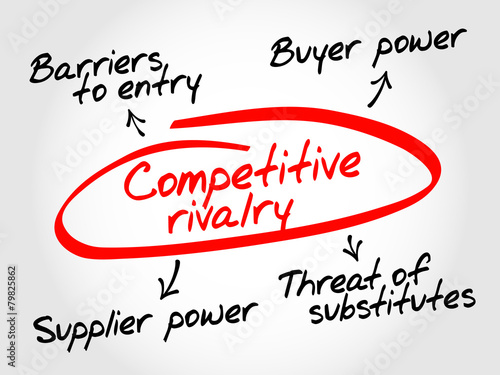
The most importance of this force is the number of competitors or rivals and their ability to threaten a company. The larger the number of competitors, along with the number of equivalent products and services they offer, the lesser the power of a company. Suppliers and buyers seek out a company's competition if they are unable to receive a suitable deal. When competitive rivalry is low, a company has greater power to do what it wants to do to achieve higher sales and profits. Secondly, a company's power is also affected by the force of new entrants into its market. The less time and money it costs for a competitor to enter a company's market and be an effective competitor, the more a company's position may be significantly weakened. An industry with strong barriers to entry is an attractive feature for companies that would prefer to operate in a space with fewer competitors. Next, this force addresses how easily suppliers can drive up the price of goods and services. It is affected by the number of suppliers of key aspects of a good or service, how unique these aspects are, and how much it would cost a company to switch from one supplier to another. The fewer the number of suppliers, and the more a company depends upon a supplier, the more power a supplier holds. Besides that, this specifically deals with the ability customers have to drive prices down. It is affected by how many buyers or customers a company has, how significant each customer is, and how much it would cost a customer to switch from one company to another. The smaller and more powerful a client base, the more power it holds. And lastly, competitor substitutes that can be used in place of a company's products or services pose a threat. For example, if customers rely on a company to provide a tool or service that can be substituted with another tool or service or by performing the task manually, and if this substitution is fairly easy and of low cost, a company's power can be weakened.
0 comments:
Post a Comment